
Why Is Mouth Breathing So Complex That the "Close Your Mouth" Method Doesn't Work?
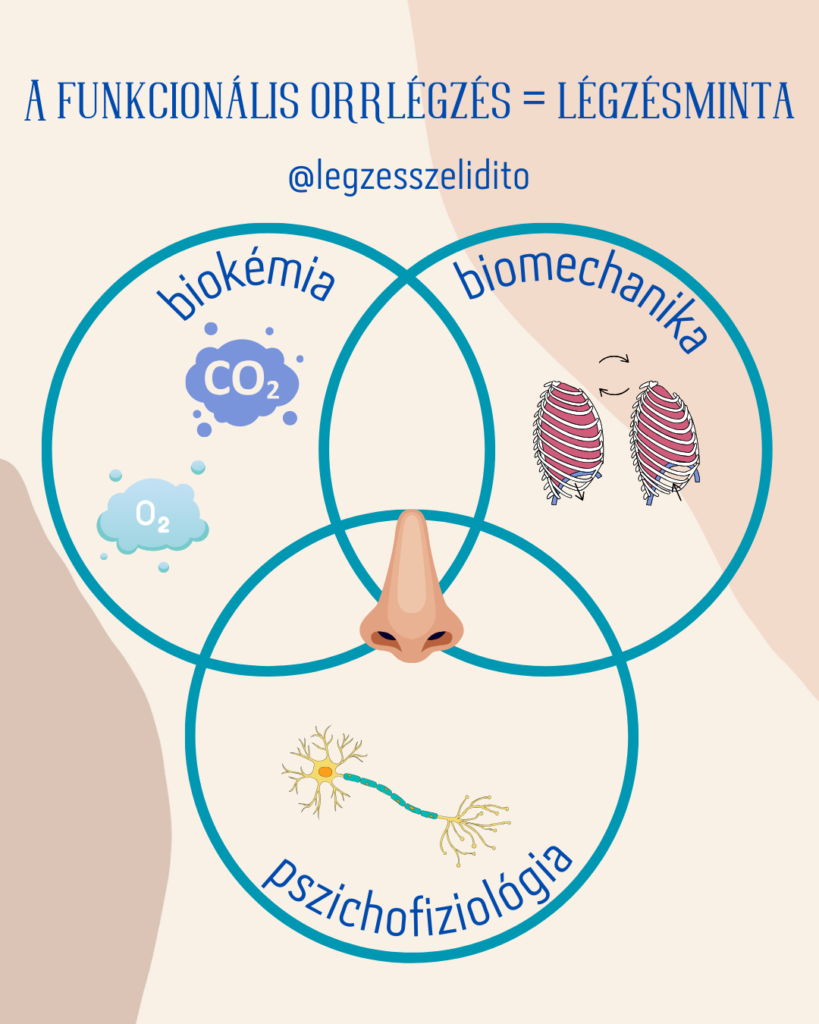
If we want to understand the complexity of mouth breathing, we need to dive deep into the 3-dimensional world of breathing. This is essentially the correct breathing pattern: functional nasal breathing.
It consists of 3 parts:
- The biomechanics of breathing:
This refers to how the muscles involved in breathing function. It can even be observed with the naked eye — for example, whether the chest or the abdomen moves predominantly.
- The biochemistry of breathing:
By this we mean the effect breathing has on our body’s carbon dioxide balance. (Not a typo! CO2 levels are more important than we tend to think!)
- The psychophysiological aspect of breathing:
This refers to the close interconnection between breathing and the autonomic nervous system.
If even one of these three areas is thrown off balance, it upsets the whole system — and this is only the breathing part; I’ll cover the tongue later.
With mouth breathing, the biomechanics shift so that the chest area moves predominantly, resulting in shallow, fast, but inefficient breathing. In this case we mainly use the upper, or sometimes the middle, part of the lungs. The diaphragm, our main breathing muscle, barely gets to play a role. Yet breathing still has to happen, so other muscles take over the diaphragm’s job and end up overloaded. (“my traps are all locked up”)
If we barely use the diaphragm, over time it tends to weaken and stops performing its important functions, such as spinal stabilization (leading to poor posture and reduced movement quality), supporting lymphatic circulation, or optimal pelvic floor function.
The biochemistry of breathing with mouth breathing takes a surprising turn. Because of the excessively large and frequent breaths, the partial pressure of CO2 in the blood drops. One consequence of this is that smooth muscles tense up throughout the body and blood vessels constrict. So blood supply throughout the body suffers, and we end up with less oxygen — even though we may have assumed that bigger breaths mean more oxygen. What’s more, the reduced CO2 level affects whether oxygen molecules can even enter the cells. At low CO2 levels, oxygen cannot release from hemoglobin (the Bohr effect), forcing cells to produce energy in an oxygen-poor environment. This is a very slow, inefficient process that also generates by-products.
Biochemistry (more precisely, our sensitivity to CO2 gas) determines how often the brain’s breathing center issues the command to take a breath. If a child’s or adult’s body adapts to a high breathing rate (overbreathing), this then becomes the new normal. Since this is an automatic process, the brain’s breathing center keeps triggering this high breathing rate and large breaths again and again, sustaining this negative spiral.
As a result of hyperventilation (overbreathing), a person experiences an increasing sense of air hunger, even at rest. It feels as though you want to take a deeper or bigger breath. There isn’t enough air! The body issues the command — open your mouth. Relief finally comes. This makes it clear how overbreathing can lead to mouth breathing, and why simply telling a child to close their mouth does absolutely nothing. That pesky automatic mechanism, which keeps triggering the pattern that causes air hunger, is still there in the background, over and over again.
Mouth breathing activates the sympathetic branch of the nervous system (fight or flight), so we switch into survival mode. This is because, over the course of evolution, we needed mouth breathing when a situation was threatening and we had to fight or flee within a short time. So mouth breathing is a survival tool — just not one meant to run around the clock!
If a child breathes constantly through the mouth, their nervous system stays in a permanent state of alert — even during sleep. This is a problem because parasympathetic nervous system activity, which is needed for sleep, keeps getting pushed into the background. Regenerative processes, reproductive processes, detoxification, growth, and digestion all end up at the bottom of the priority list. After all, in a stress situation these are secondary.
Both overbreathing and mouth breathing reinforce the nervous system’s survival mode, meaning poor breathing can make a person stressed and anxious — and the automatic biochemical mechanism keeps them stuck there. That’s why it would be important to examine the breathing characteristics of people who are anxious or depressed.
To be continued soon…