
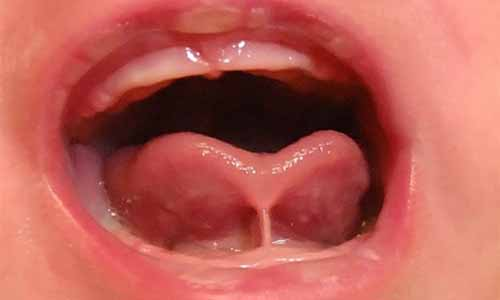
What is the tongue-tie, and where is it located?
The tongue-tie (lingual frenulum) is a small band of connective tissue located on the underside of the tongue, anchoring it to the floor of the mouth. You might wonder—does everyone have one? In general, yes. However, its length and flexibility are what really matter. A short, tight, or thick tongue-tie can restrict tongue movement, which can interfere with its proper function.
Very few people are aware of this connection, but the tongue is linked to the entire body through fascial chains (connective tissue networks). One such chain, known as the deep front line, runs from the soles of the feet, through the hyoid bone, all the way up to the skull. This is why the condition of your tongue-tie can affect your posture and the quality of your breathing.
It’s also useful to know that a short tongue-tie is often accompanied by a short lip tie or buccal tie. For example, a short upper lip tie can create a gap between the upper front teeth (diastema).
At What Stages of Life—and How—Can a Tongue-Tie Cause Limitations?
1. Right from birth, it can cause difficulties during breastfeeding. In such cases, the infant typically feeds very slowly and inefficiently, which can lead to poor weight gain or even stagnation. It can be observed that the baby struggles to latch properly, frequently detaches from the breast, and may swallow excess air. This can lead to bloating, abdominal discomfort, and increased crying. Breastfeeding can also become painful for the mother, often causing nipple soreness, wounds, and irritation. These issues can make feeding more difficult and may threaten the long-term success of breastfeeding.
I experienced this myself with my son, exactly as described above. While we were still in the hospital, I asked a neonatal nurse to check his tongue-tie because we were constantly having problems. The nurse didn’t find anything unusual. When my son was one month old, we finally managed to get a lactation consultant to visit us—after several attempts—and she immediately identified that he had a tongue-tie. At the time, I wasn’t as informed as I am now. I only knew that a short tongue-tie could interfere with successful breastfeeding. Our case is a clear example of how important it is to find a truly knowledgeable professional.
At this age, it is the easiest to resolve: a quick snip, performed under local anesthesia, can solve the issue, allowing breastfeeding to continue. This is what happened with my son as well, but afterward he had to relearn how to breastfeed. In such cases, the tongue moves within a new range of motion, which needs to be relearned, controlled, and coordinated.
An interesting observation—based on my own assessments—is that babies and children with one-sided tightness or a tilted head posture (often called a “C-shaped” position) frequently also had a short tongue-tie. The same pattern can be seen between asymmetrical crawling and tongue-tie. (I’ve often heard parents say that asymmetrical crawling isn’t important, as long as the child eventually crawls. However, when we learn and perform movements, it’s not just the muscles that are working—the nervous system is involved as well. If a movement is asymmetrical and repeatedly practiced, that pattern becomes ingrained in the nervous system. A good example is my own son: even now, at 3.5 years old, when I occasionally see him crawl, he still does it asymmetrically—despite having learned to crawl properly.)
International perspective: In Brazil, for at least the past decade, it has been mandatory to screen all newborns for tongue-tie.
2.Introduction of solids, eating: During chewing, the tongue may not move efficiently enough, making eating slower and less effective. The opposite can also occur: some children eat too quickly and swallow food after only a couple of bites without proper chewing.
3.Mouth breathing:This can develop at any age as a result of a short tongue-tie. When the tongue is not resting on the palate, the mouth opens much more easily, promoting mouth breathing.
4.Speech development: A short tongue-tie can make articulation more difficult, causing a child’s speech to be harder to understand. In many cases, articulation therapy is needed, but it may have limited effectiveness. In such situations, it’s important to consider the possibility of a tongue-tie. Ideally, a speech therapist should assess the tongue-tie during evaluation.
In such cases, it should not be assessed based on appearance alone, but also functionally—by observing it during different movements and in its proper resting tongue position.
5.Tongue thrust swallowing in childhood and adulthood: This dysfunctional swallowing pattern can be easily identified by observing a child’s lips and facial muscles during swallowing. If there is even slight movement around the mouth, it likely indicates tongue thrust swallowing. Diagnosis is typically the task of a specialized speech therapist, and it can be treated with therapy from around the age of 7–10 (this depends on the therapist—some do not start before age 10).
In this condition, a short tongue-tie restricts tongue movement, preventing proper swallowing. Therefore, it is crucial to assess the tongue-tie before starting therapy. Among the mouth-breathing or poor-breathing-pattern children I’ve worked with, around 80% also had tongue thrust swallowing—and nearly 100% had some form of dental misalignment.
6.Adolescence and adulthood – orthodontics: Tongue thrust swallowing (see point 5) can lead to dental changes. With each swallow, the tongue pushes against the upper front teeth, gradually moving them forward. This is commonly referred to as “buck teeth.” In some cases, it doesn’t just affect the upper incisors but can also create an open bite, where the upper and lower teeth no longer meet properly. If such issues are present, the first priority is to correct the tongue thrust swallowing pattern—only after that should orthodontic treatment follow. Many of my clients have reported going through multiple rounds of orthodontic treatment, only for their teeth to relapse after a short time.
The reason: Improperly functioning habits (such as breathing and swallowing) and unresolved myofunctional issues (proper functioning of facial muscles). Muscular forces are what move bones and teeth. If these dysfunctional forces are not addressed, they will continue to act on the corrected teeth, eventually causing them to shift back out of alignment.
7.Teeth grinding, sleep apnea, snoring. These issues can occur at any age, and a short tongue-tie may be one of the contributing factors. When the tongue is not in its proper position, the muscle tone of the airway (pharyngeal muscles) decreases, increasing the risk of sleep apnea.
8.Jaw pain, TMJ disorders, teeth clenching, headaches. As mentioned earlier, the tongue is connected to the entire body through fascial chains. If the tongue-tie is short, it can create tension and restriction throughout the body, leading to jaw pain, clicking in the temporomandibular joint (TMJ), and even headaches.
9.Movement quality and sports performance. A short tongue-tie often prevents proper tongue posture, which can reduce balance and make stabilization exercises more difficult. Proper tongue position supports optimal posture and has even been shown in research to improve force production in strength sports. Tension and altered joint mobility caused by a short tongue-tie can lead to poorer movement quality, which increases the risk of injury. In this sense, a tongue-tie can quite literally hold you back in sports—especially if it is short and not functioning properly.
Case Study
In the spring of 2024, a woman attended my Buteyko breathing training who mentioned that she had previously undergone unsuccessful orthodontic treatments, among other issues. During the course, tongue function plays an important role, so we assessed it for everyone. She had difficulty finding the correct tongue position and said something like, “It feels strange when it’s in the right place.” To me, this clearly meant that her tongue wasn’t usually resting there. I tried several different approaches to help her become more aware of the correct position, and in her case, using menthol chewing gum turned out to be the most effective method.
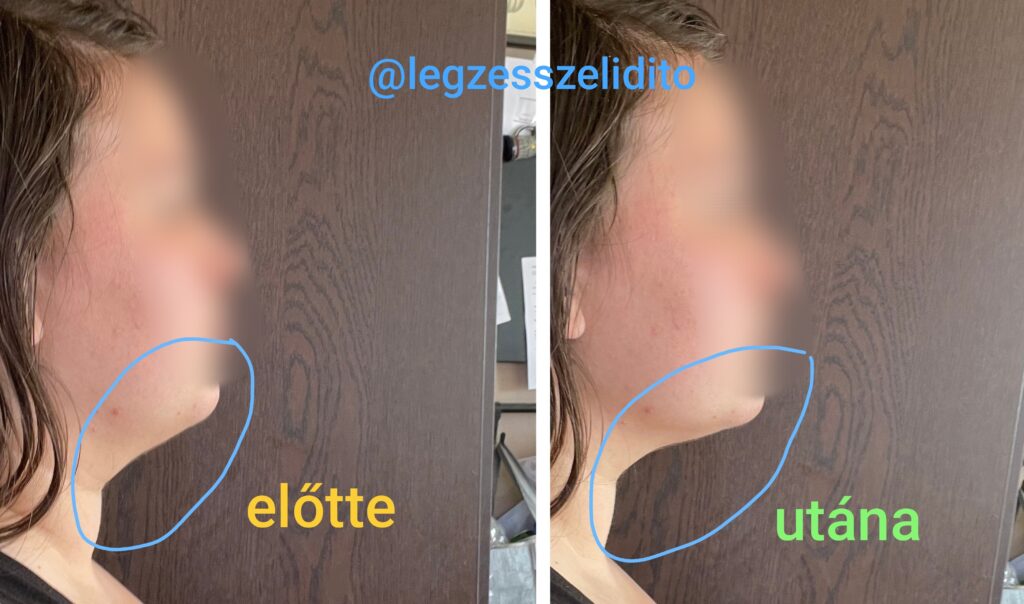
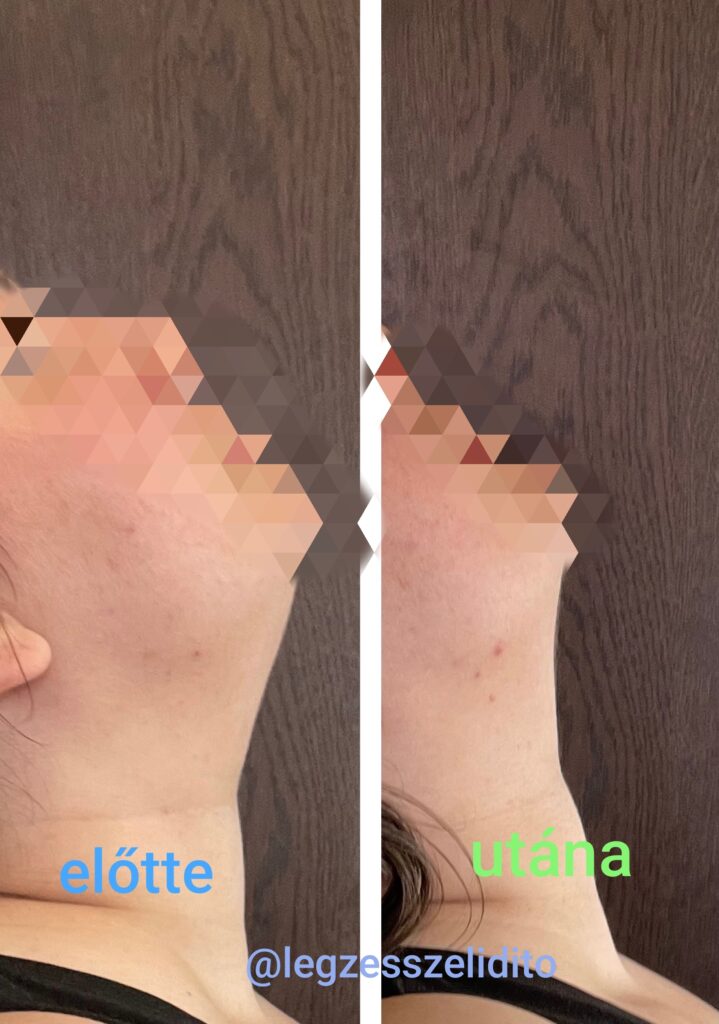
In the spring of 2025 (as I’m writing this), she reached out to me to say that she had her tongue-tie examined—and it was released. She also sent me photos, which I have permission to share. The change is remarkable. The before-and-after images clearly show how significant the improvement can be, almost immediately.
She reported the following three changes almost immediately:
- Her sleep quality improved, and she has been sleeping more deeply since.
- A long-standing lymphatic congestion near her collarbone began to loosen and decrease, even though it had not responded to exercise or massage before.
- Her balance and stability exercises became easier to perform.
Solutions for a Short Tongue-Tie:
A qualified speech therapist can determine whether the tongue-tie is slightly restricted but still stretchable with targeted exercises. If it can be stretched and mobilized, specific speech therapy exercises may help improve function. However, if there is no progress after a few months, a surgical procedure may be necessary.
Tongue-tie release is generally performed in two ways: with a scalpel or with a laser. International practitioners often prefer the laser method, but it’s worth considering another professional perspective as well. According to my colleague Gabriella Hevesi, an experienced speech and swallowing therapist, laser procedures can sometimes be less precise, and the cut may not be sufficient—potentially requiring a second intervention. Therefore, it’s important to carefully weigh the options when choosing the type of procedure.
What they all have in common—regardless of the method used—is preparation and rehabilitation. From what I see, internationally there are already tongue-tie procedures guided by osteopaths, where the body is treated as a whole, integrated system. There is also strong emphasis on preparing and strengthening the tongue beforehand through myofunctional exercises. Since a short tongue-tie creates tension within the fascial network, craniosacral therapy can also be beneficial both during preparation and throughout rehabilitation. According to my colleague Gabi, tongue exercises should begin as early as 7–10 days after the procedure to ensure proper healing of the scar tissue and to maintain its flexibility. In addition, the tongue must learn to function within a new range of motion, which affects articulation, swallowing, and proper resting tongue posture as well.
A short tongue-tie can therefore hold you back and limit you in many areas of life. If reading the symptoms above has given you a moment of realization, it’s important to seek a comprehensive, multidisciplinary solution.
My excellent colleagues and I work as a team to ensure that everyone who turns to us receives a holistic, health-focused approach—with lasting results.
If you’d like support with this, feel free to get in touch with me.
Interested in breathing and would like to explore some free content? Then the 1.5-hour podcast below is a great place to start.